







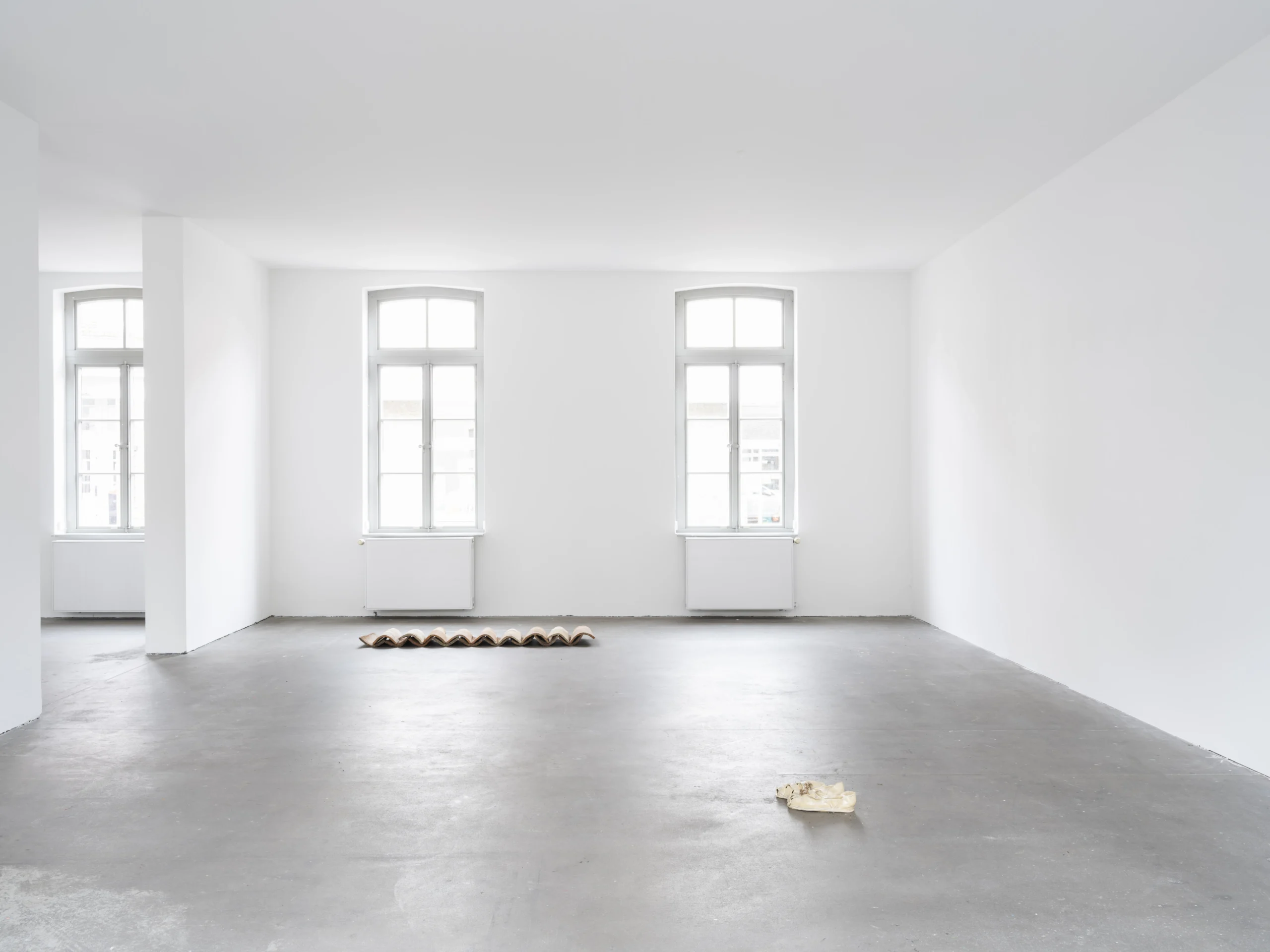
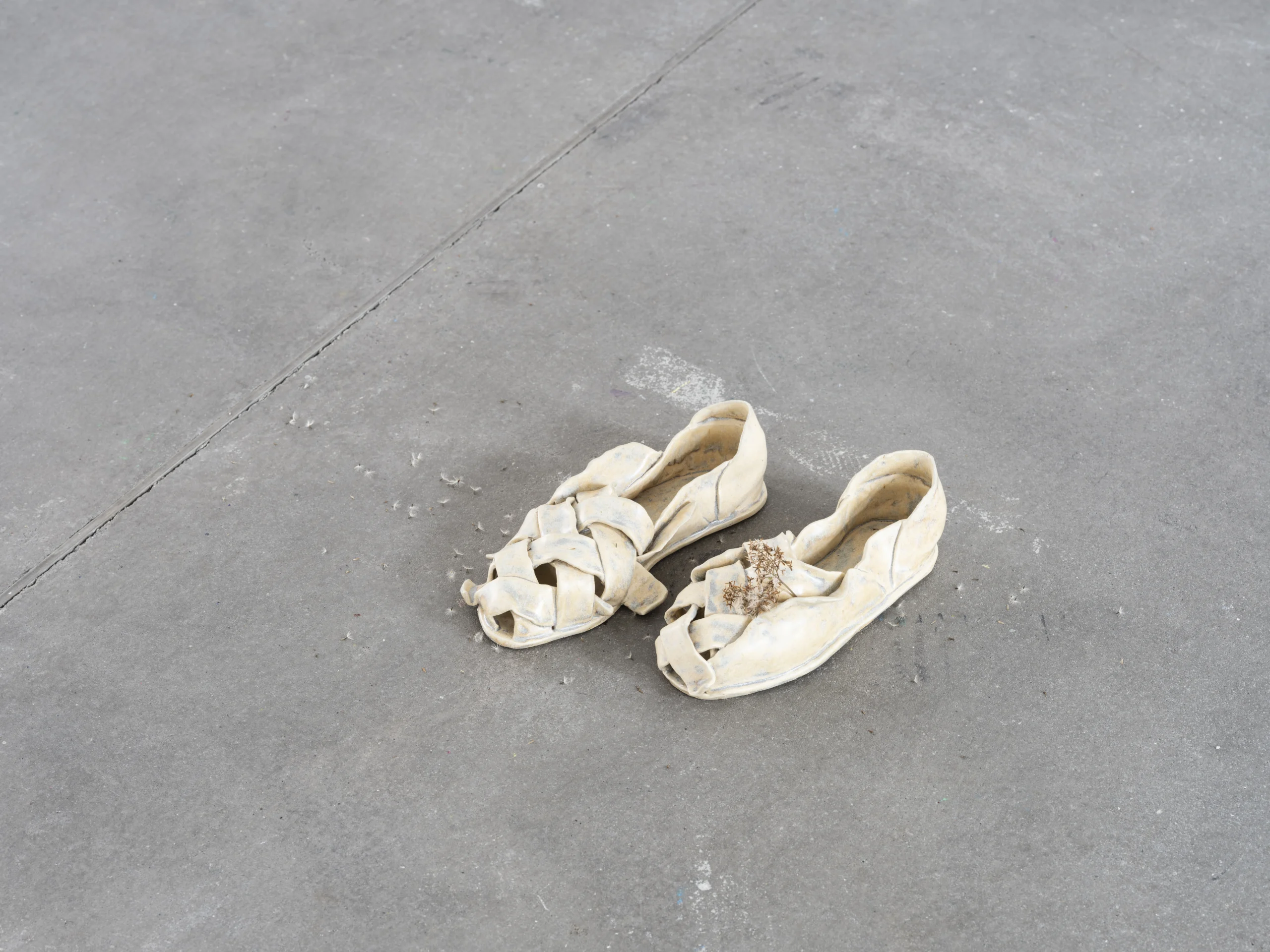
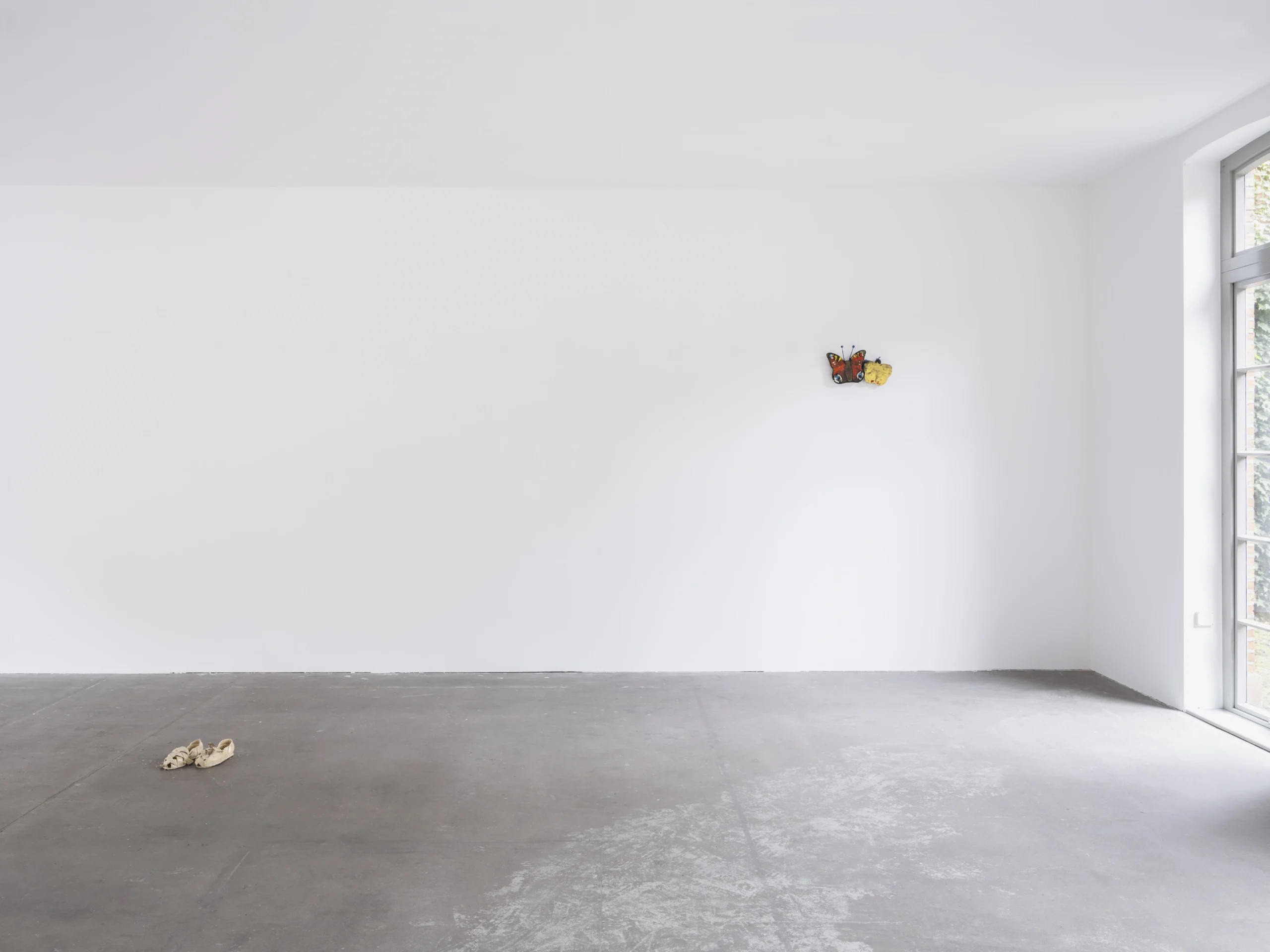



Vincent Simon: Gleaners
I learned exactly what gleaning is—in its legal definition—thanks to Agnès Varda, whose 2000 Les Glaneurs et la glaneuse (The Gleaners and I) addresses the phenomenon. I really liked that scene with the judge in his robe quoting the Napoleonic Code in a field of cabbages that had gone to seed after the harvest. I discovered that what I had considered a tolerated offense was in fact a right—a remnant of an old medieval law formalizing the duty of charity, which allows anyone to gather fruit, vegetables, or grains left behind after the harvest, thereby creating a commons on the fringes and along the edges of private property.
In her travels, Varda meets rural residents (a bar owner, a retiree, a farmer) who share their memories of gleaning; others who glean today in the fields or at markets to survive; a vegetarian who eats and lives “100% off the trash” out of conviction; paintings of gleaners (by Millet, Breton, and a painting found at a flea market where the gleaners from these two works meet).
The exceptional success of Varda’s film—the numerous awards it won, its popularity with audiences, the enthusiastic response from viewers expressed through a voluminous correspondence addressed to the filmmaker, and requests to make a “Gleaners 2,” to which she responded with the film Deux ans après (Two Years Later) as a way of saying thank you—deserves our attention. Varda dedicated her film to contemporary gleaners, most of whom are “excluded”—from work, housing, family, and society—to whom she gives a voice and the leading role.
What feelings do we—who are “included”—usually experience when faced with these people? A mixture of embarrassment and pity. Two feelings that concern us: embarrassment because another’s misery exposes our selfishness and our lack of generosity (we are embarrassed by ourselves and what we judge to be our moral failure); pity because we identify with them, recognize them as our fellow human beings, and feel the need to see their misery alleviated. Two feelings, each just as selfish as the other, but this is undoubtedly the foundation of morality (we have access only to our own emotions).
The film’s quality stems from the fact that Varda speaks to everyone in the same way, reaches out to people, asks them questions, and gives them a voice. This friendly elderly woman, with her mini-DV camera and small crew, undoubtedly inspires their trust. Her commentary—which blends observations, remarks about what she witnesses, reflections on the film in the making, and her own aging—is delivered from a unique perspective that makes no claim to objectivity (unlike a television news report). The camera captures the gleaners, the employers, but also Varda herself (the film is also a self-portrait). Varda is on both sides (a constant in her documentary filmmaking, which always takes on a first-person-perspective), and that is what is so appealing about her: she is present, on the same level as her subjects; she does not give the impression of looking down on them (or us); she speaks her mind, and we either agree or disagree.
As I watched Varda’s gleaners on YouTube and Millet’s gleaners at the Musée d’Orsay in Paris, I thought: these gleaners aren’t working (in Millet’s painting, the workers—farmhands and the foreman—are in the background; likewise in Varda’s film, they’re part of the scenery, but the characters are the gleaners—and the landowners, who exist in the reverse shot or off-screen, the ones who decide whether to allow gleaning and to what extent. Gleaning may be a right, but it takes place on private property, in a field that’s already been harvested, between sunrise and sunset; it is up to the owner to ensure that the rules are followed). Yet they go about their business, thereby providing for themselves and feeding their families. It resembles work; it fulfills certain functions of work, but it is not work, because there is one function it does not satisfy: the employer has nothing to gain from it.
I admit that I didn’t pay much attention to Jean-François Millet for a long time, until I discovered two of his late works housed at the Musée d’Orsay: Le Bouquet de marguerites (The Bouquet of Daisies, 1871–1874), a sensual, resplendent painting in which a young woman gazes at us from the cool shadows of the room, half-hidden by the bouquet resting on a windowsill; Le Printemps (Spring, 1868–1873), a rather magical painting, with apple trees in bloom in the foreground and, in the background, a dense forest beneath a stormy sky spanned by a rainbow—a stir in the air that seems to herald a storm. In these two works, we see the artist’s ability to create images so powerful that they can become archetypes—hence the unique fate of L’Angélus (The Angelus) and the Glaneuses. But they were sufficiently different from the image I had of his work to make me want to look beyond the cliché of the peasant painter and, in my eyes, restore the reputation of an artist who, in France at least, is paradoxically marginalized because of the iconic and popular nature of his work.
After being commissioned to write this text, my research led me to discover the story of a man born into a peasant family dominated by the figure of a deeply devout grandmother, who left his native countryside to study art in Cherbourg and then in Paris, enrolled at the École des Beaux-Arts, failed the Prix de Rome twice, and began a career as a painter divided between commissioned portraits of the Norman bourgeoisie and lighthearted scenes with mythological themes—which earned him the reputation as the “official specialist in throats and buttocks,” according to one of his earliest biographers. Painting to support his wife and children, by an artist caught in between: neither academic nor avant-garde. Then came the 1848 Salon—the year of the revolution that established the Third Republic—where he presented a historical painting (which he would later cover with a peasant scene) and a genre scene, Un Vanneur (A Winnower), which marked his entry into a career as a peasant painter (“a true peasant,” as he put it). The following year, he left Paris to settle in Barbizon, a village on the edge of the Forest of Fontainebleau, where the population was half peasant, half urban, and where a large community of artists lived—a village that today we would call gentrified. Always in between. He rediscovered the rural world he loved, but not his native Normandy. He lived in the countryside but did not mingle with the farmers.
Millet did not work from life, nor did he make sketches of what he saw; instead, he took notes in a notebook. The important preparatory sketching work leading up to the creation of a painting was done in his studio, from memory, drawing largely on his childhood memories. His choice of the rural world as the primary—if not exclusive—subject of his art was both aesthetic and moral. In the 19th century, the First Industrial Revolution led to urban expansion, the depopulation of the countryside, and the breakdown of traditional values. Family ties weakened, the church lost its power, and the cabaret became the counterpart to the factory for peasants who had become factory workers. Millet, the peasant, could not find his place—artistic, social, or economic—in Paris. In the countryside, he reconnects with his roots, finds an identity of his own, and becomes unique: he can enter history.
In Millet’s work, the figures lack individuality; they are archetypes that have been meticulously refined and often repeated from one work to the next. His peasants are anonymous; his women almost always have their heads bowed, humbly focused on their work. They embody the moral values of the peasant world: one works hard, one does not complain, one lives in tune with the animals and the seasons, one prays to God.
Millet was regarded as a socialist after 1848—his Glaneuses, exhibited at the Salon in 1857, were interpreted as a condemnation of peasant poverty, whereas they are undoubtedly much more of a tribute to the humble act of bending down to gather what others have left behind. After 1871 and the crushing of the Paris Commune, the French bourgeoisie viewed the rural world as a potential political ally against the working class and saw Millet as the perfect propagandist for an eternal France that respected the established order. The French government spent exorbitant sums to bring L’Angélus and the Glaneuses into the Louvre at the end of the 19th century. Thus began Millet’s long purgatory. Having become an official artist posthumously, he was ignored by the modernist narrative and snubbed by the enlightened public, who saw him as the painter of a world that no longer existed.
It is no surprise that in France, it was a filmmaker who enabled people to look at—and appreciate—these gleaners once again. Someone who disregards the uniqueness and aura of artworks, for whom painting is an image and a vehicle for a message, is interested in how it circulates and what is made of it. Much like the Mnemosyne Atlas, her film traces the repetition of the same figure, the same gesture—bending down, picking up, standing back up—the gesture of a mother, a servant, a homeless person—in the city, in the countryside, in art, in life—the emergence of the subaltern gesture as a model, not of resistance, but of survival.