


Palmo panorama — what a strange title. That was my first thought when Marco Emmanuele showed me the draft of the invitation to the opening of his solo exhibition at the LABS gallery. And yet, thinking about it, the two words placed side by side manage to express and hold together the different tensions of the exhibition: the contained measure of a palm and the extended one of a panorama; the infinitesimal and the colossal; up to arriving — with a small mental leap — at the friction between the limited space of the studio and the potentially boundless space of the landscape.
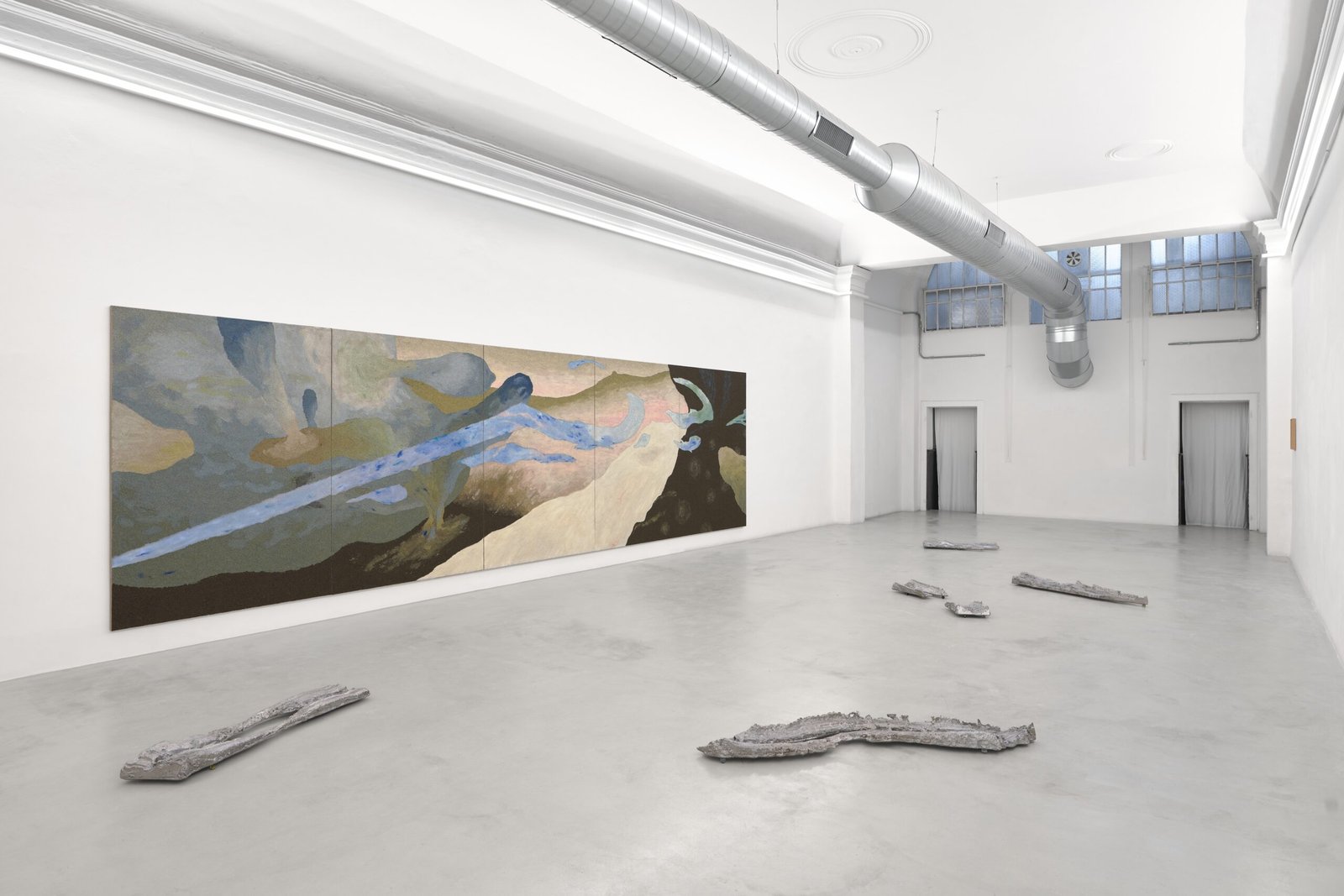
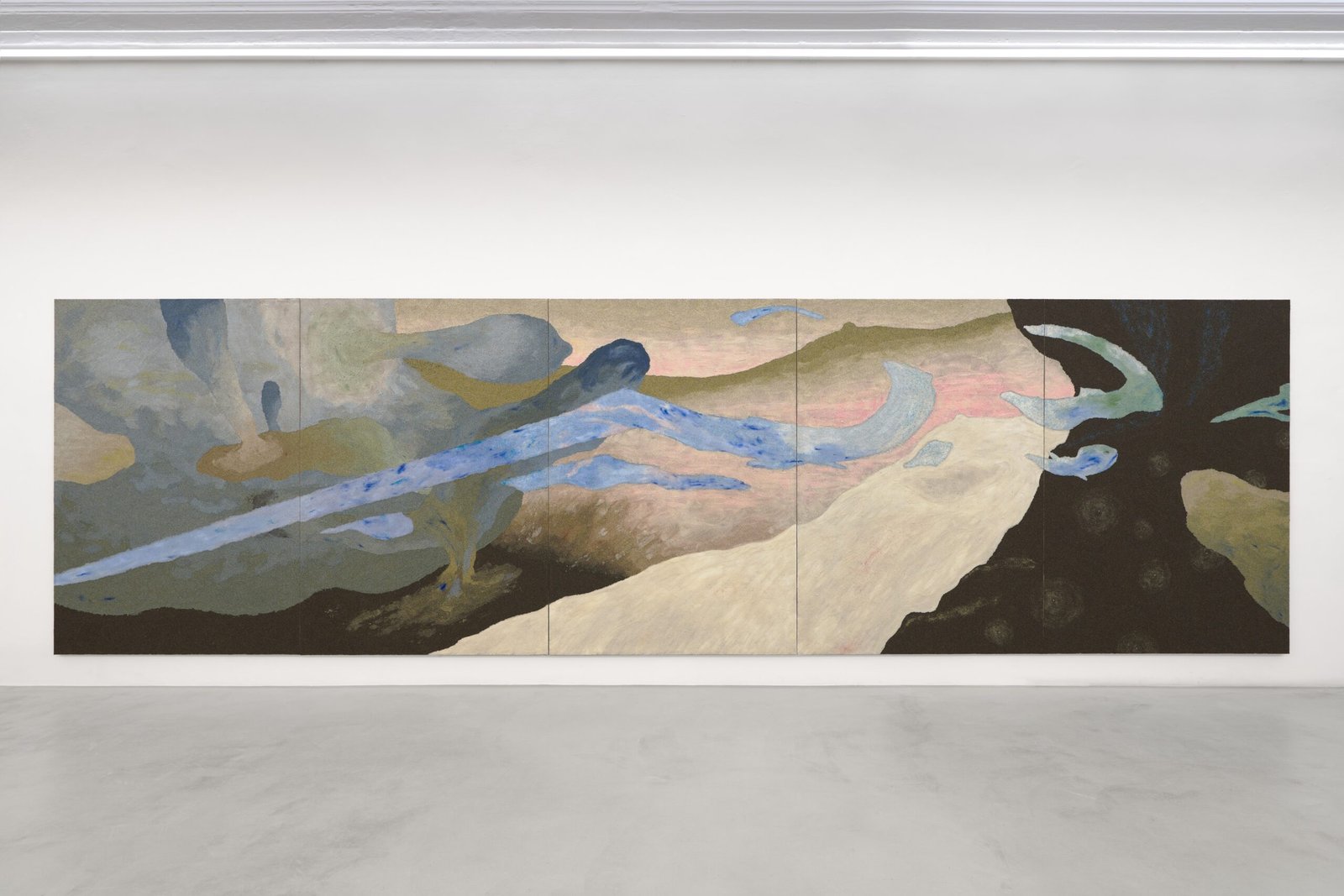
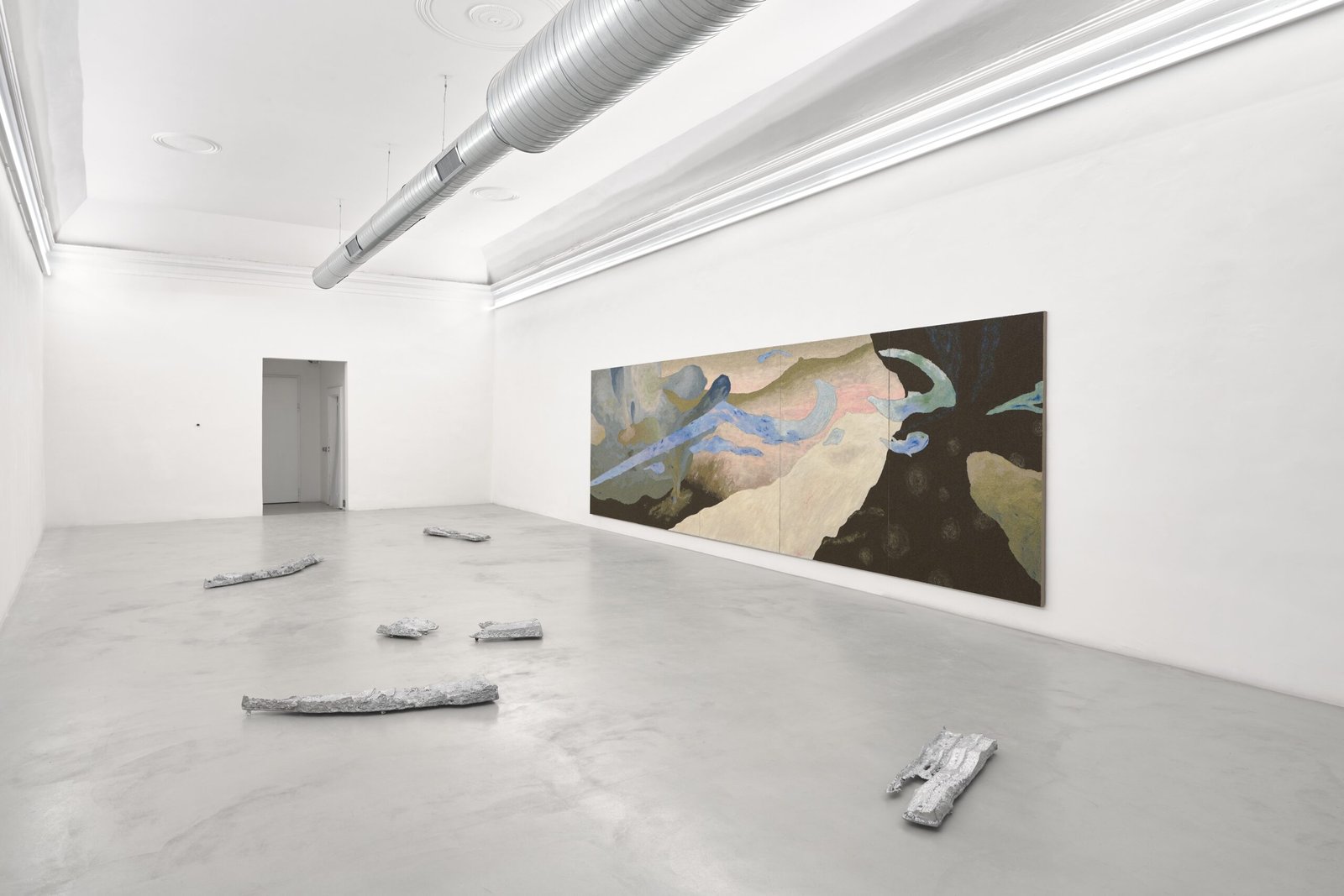
These dualities are also displayed in ISO #250: a work of ambitious scale — practically the size of a football goal — yet one whose strength lies in a multitude of tiny particles, an aggregation of glimmering elements. Who knows how many grains of sand and glass fragments this work contains — probably the “queen” piece of Palmo panorama, if only for its dimensions. The first time I saw it in the artist’s studio, I had to take a few steps back to take it in fully, and then photograph it with my phone’s camera. It is striking to think that such a vast surface is made of microscopic parts, only seemingly the result of broad brushstrokes. Those familiar with Marco Emmanuele’s practice know well that his artistic process is grounded in a technique closer to mosaic; or, more precisely, a strange meeting point between painting and mosaic, between laying down color and arranging small elements. The artist does not use brushes but a spatula with which he spreads onto the canvas this mixture of glass and sand, like a builder working on something entirely different from a building — devoted to poetry rather than construction.
The result is astonishing: the crushed glass from old bottles, mixed with sand, returns to a new life in the form of an abstract landscape. A landscape in which the elements — earth, air, water or something very similar to them — seem to compete for space, intertwining in a vortex. It almost feels like witnessing the creation by some timeless deity (“an unknown and messy god,” to quote a poem by Valentino Zeichen dear to the artist). I don’t know whether Emmanuele’s works truly possess a point of view, an orientation, or specific coordinates; nonetheless, I like to imagine that he seeks to suggest a vertical gaze, as if ISO #250 were a territory seen from above. Despite the hypothetical distance, the crust of this Pangaea is easy to perceive: a rough and precious “skin” that, thanks also to the large format of the canvases, embraces the viewer who stands before it. The gallery thus acquires a horizon that breaks through the white walls of the space: in this sense, I find the idea fascinating that ISO #250 might be read as a huge window onto an imaginary landscape.
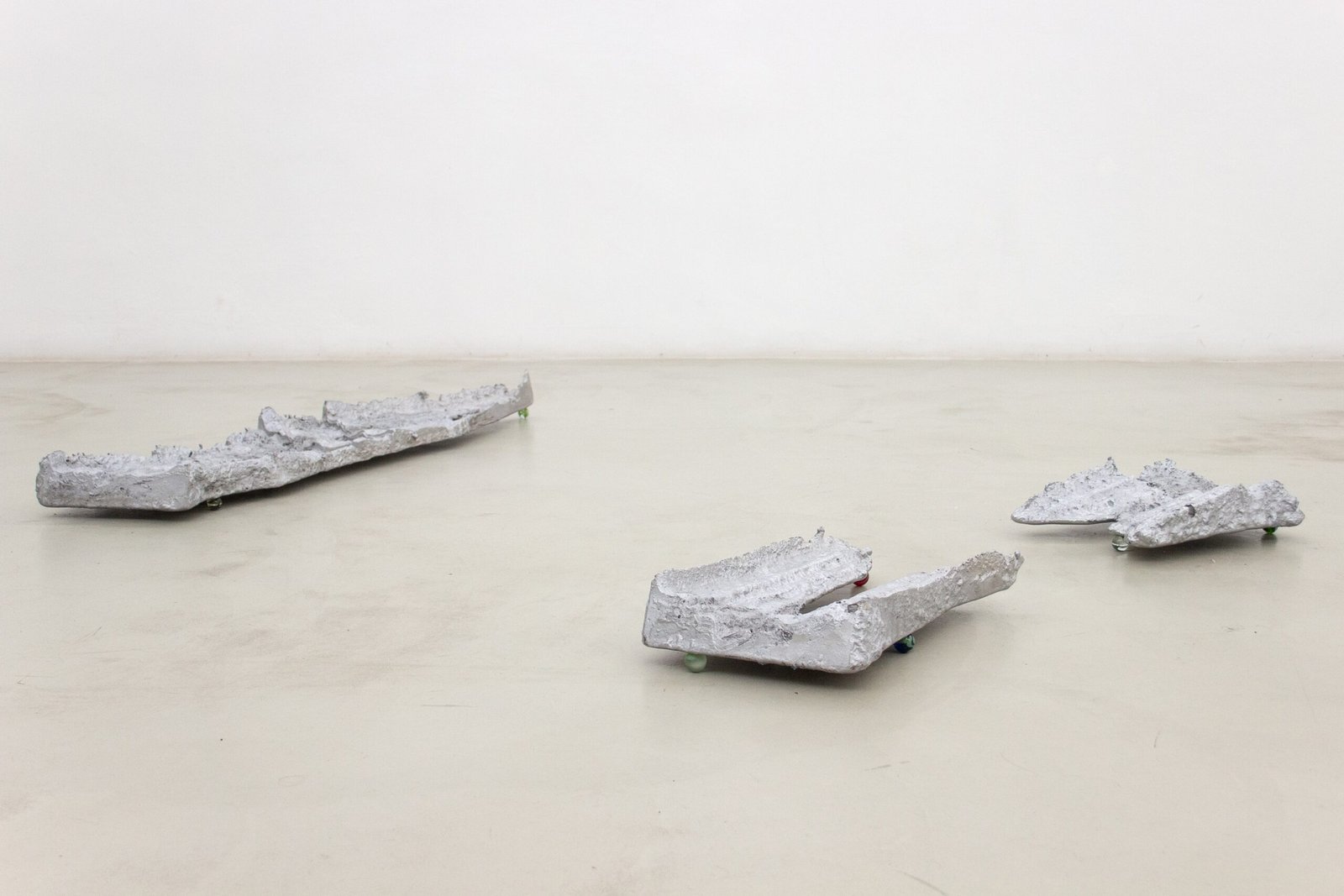
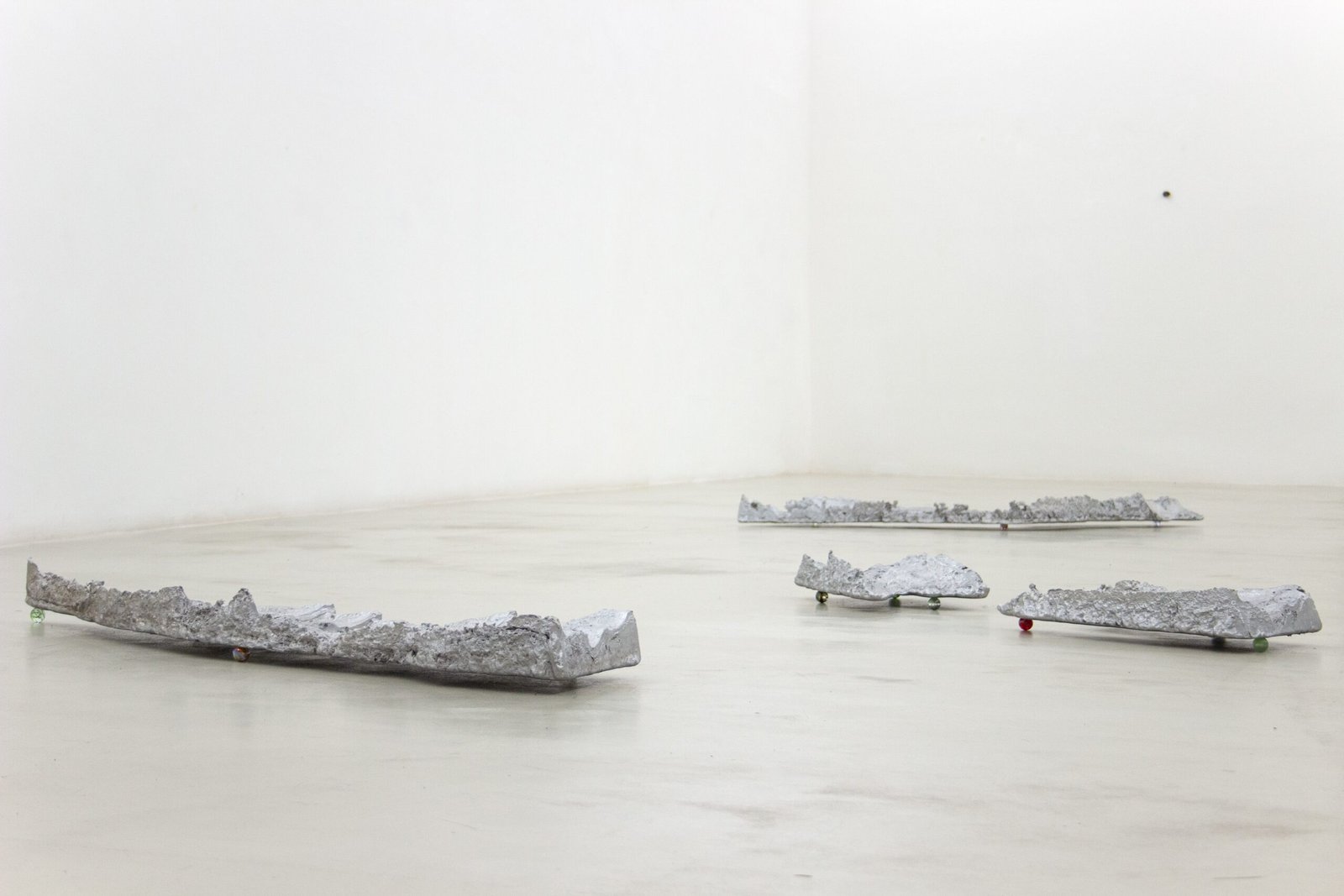
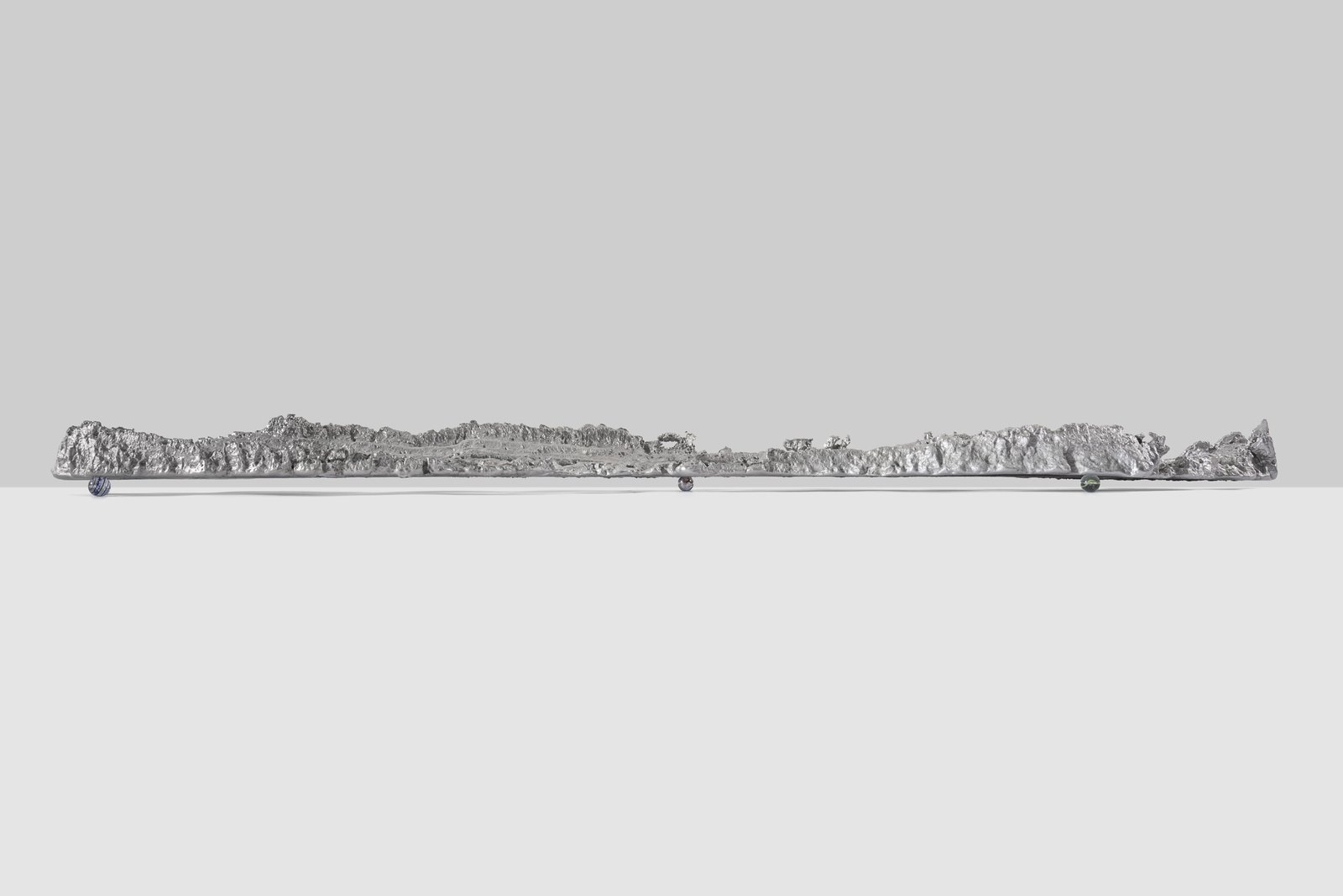
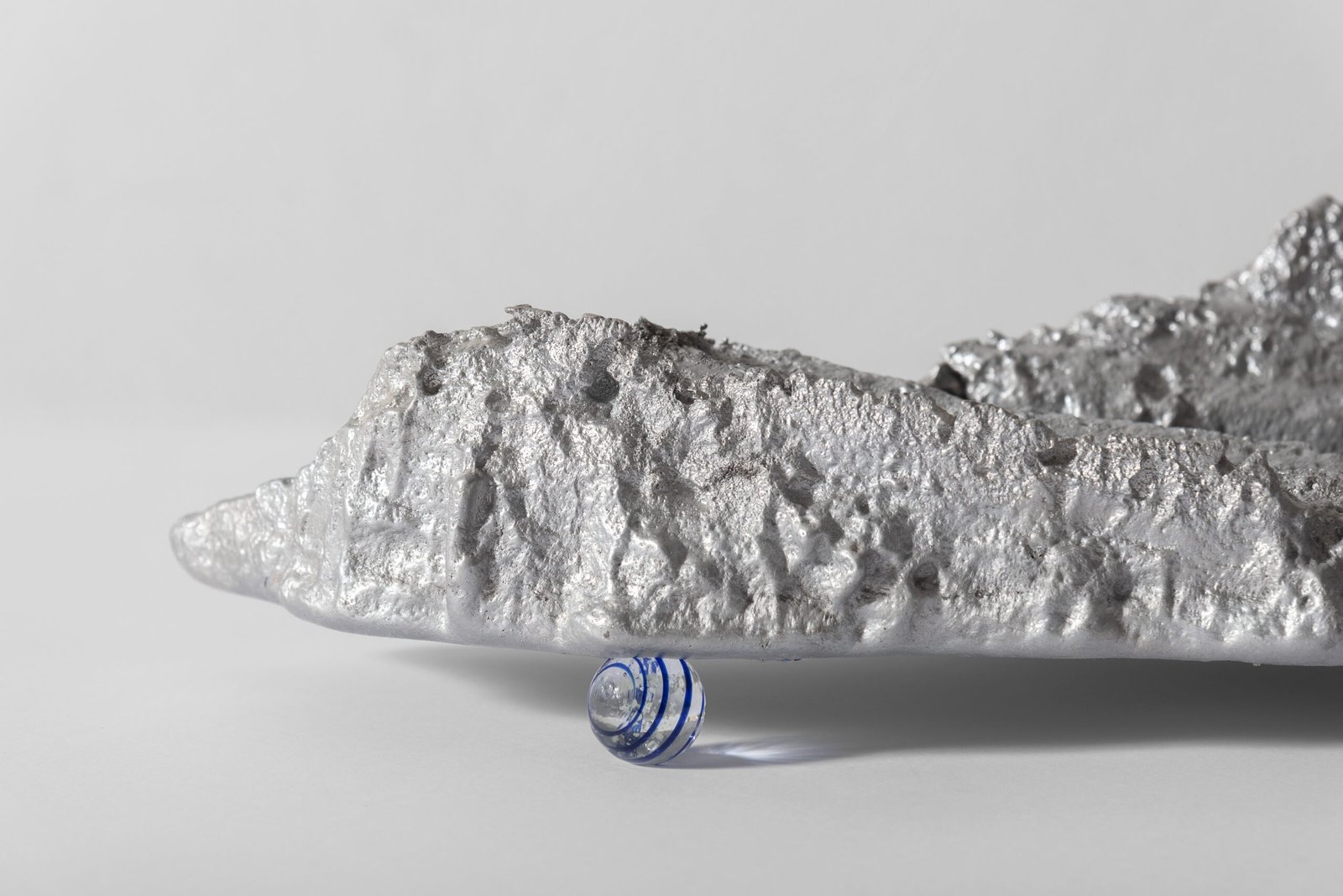
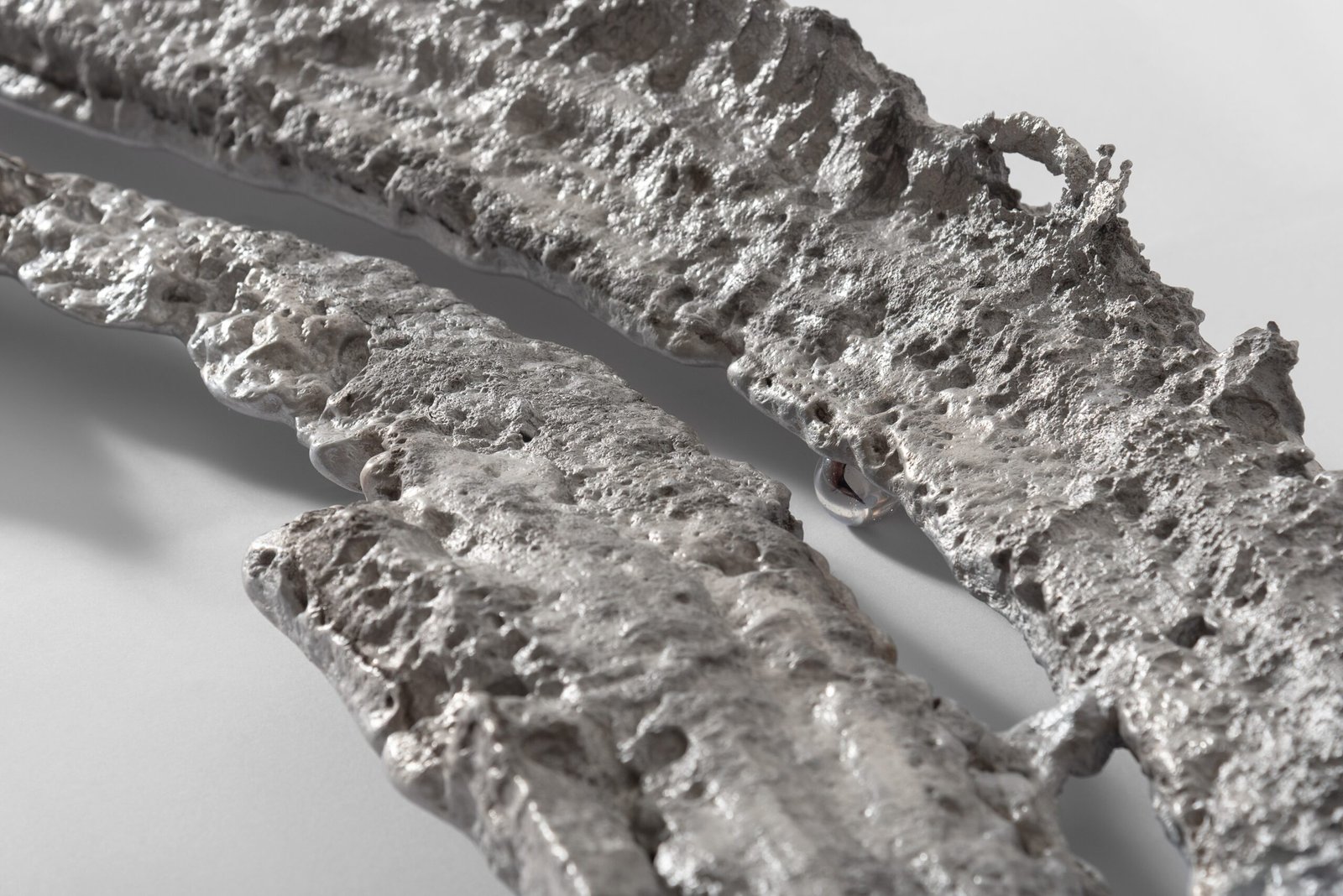
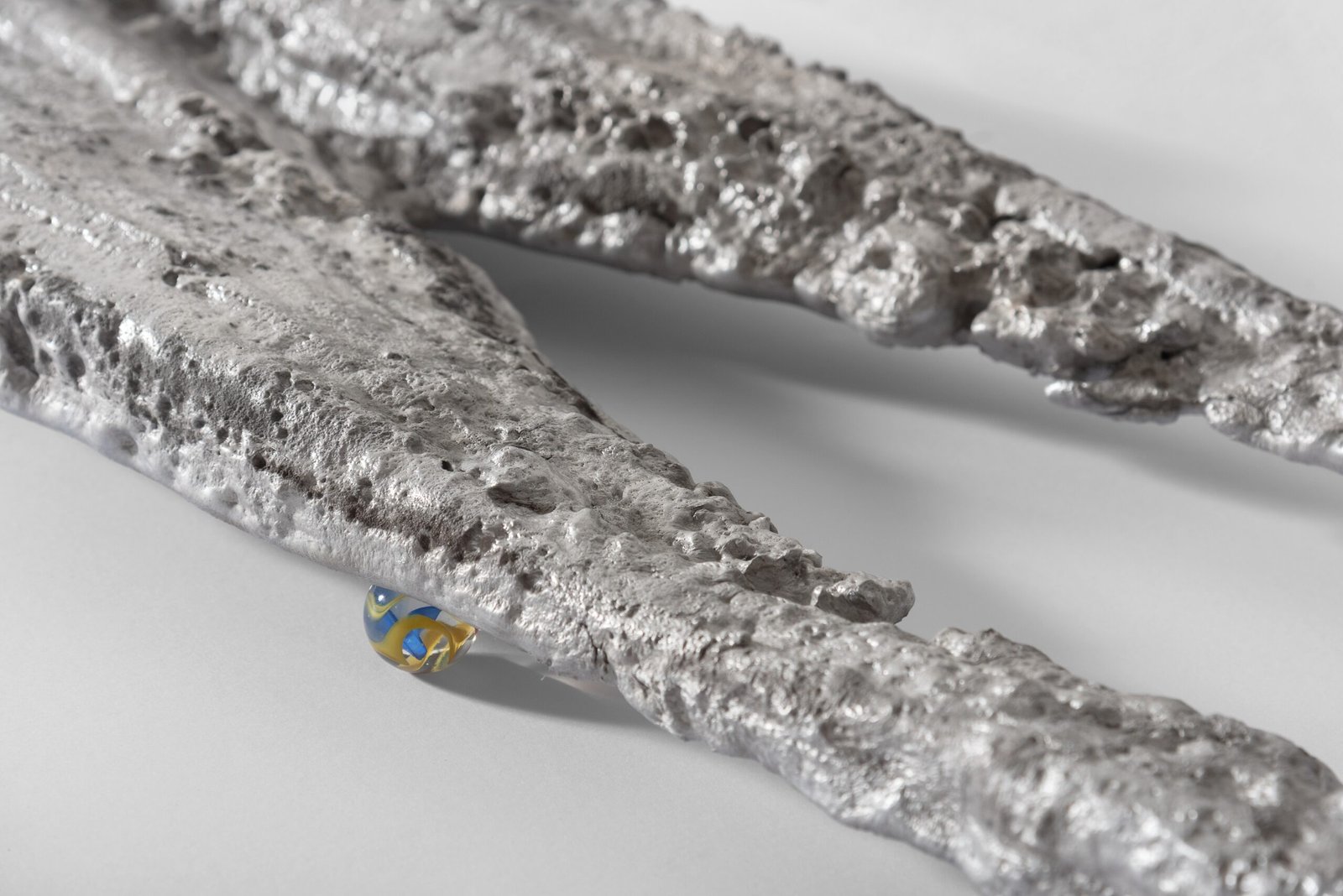
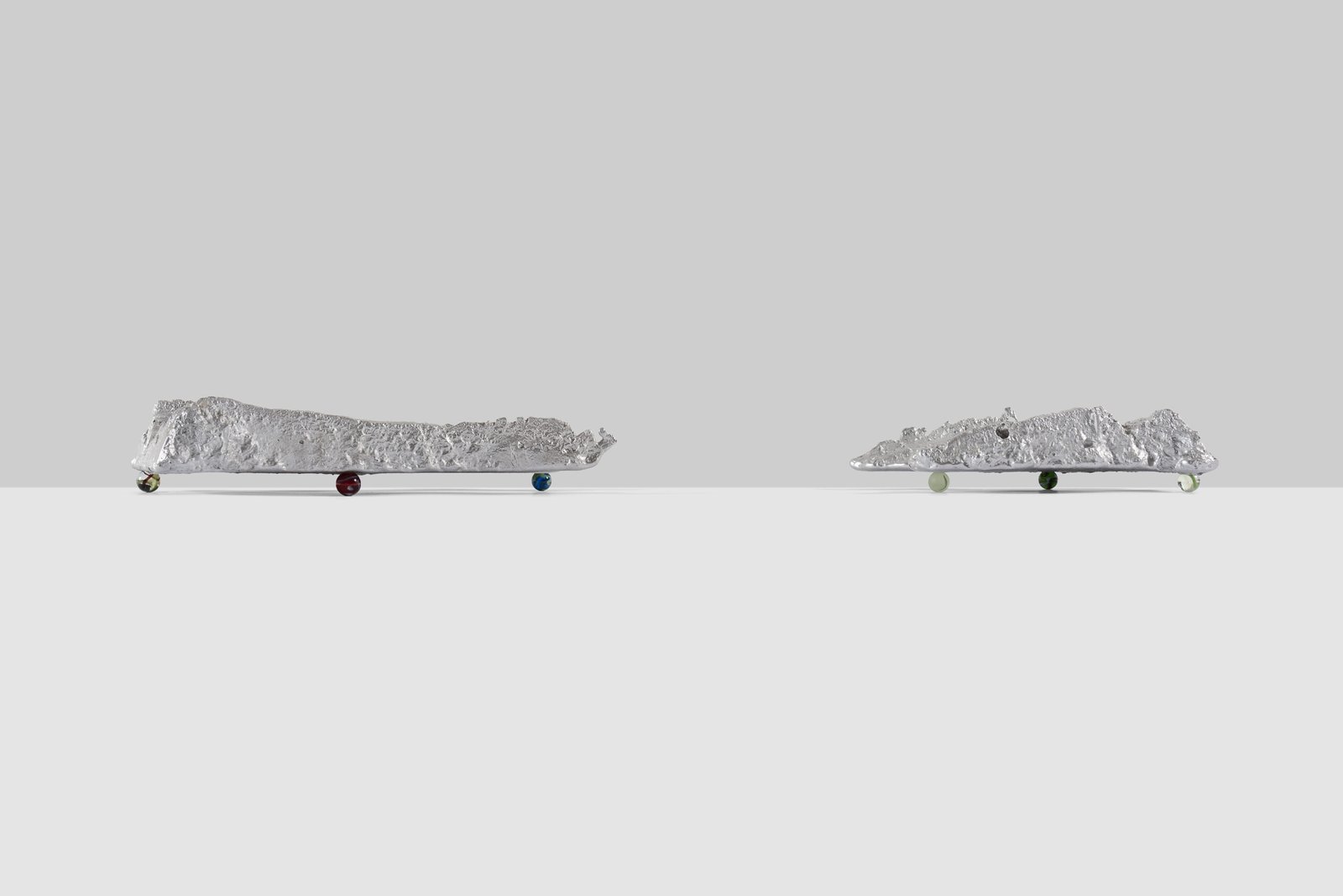
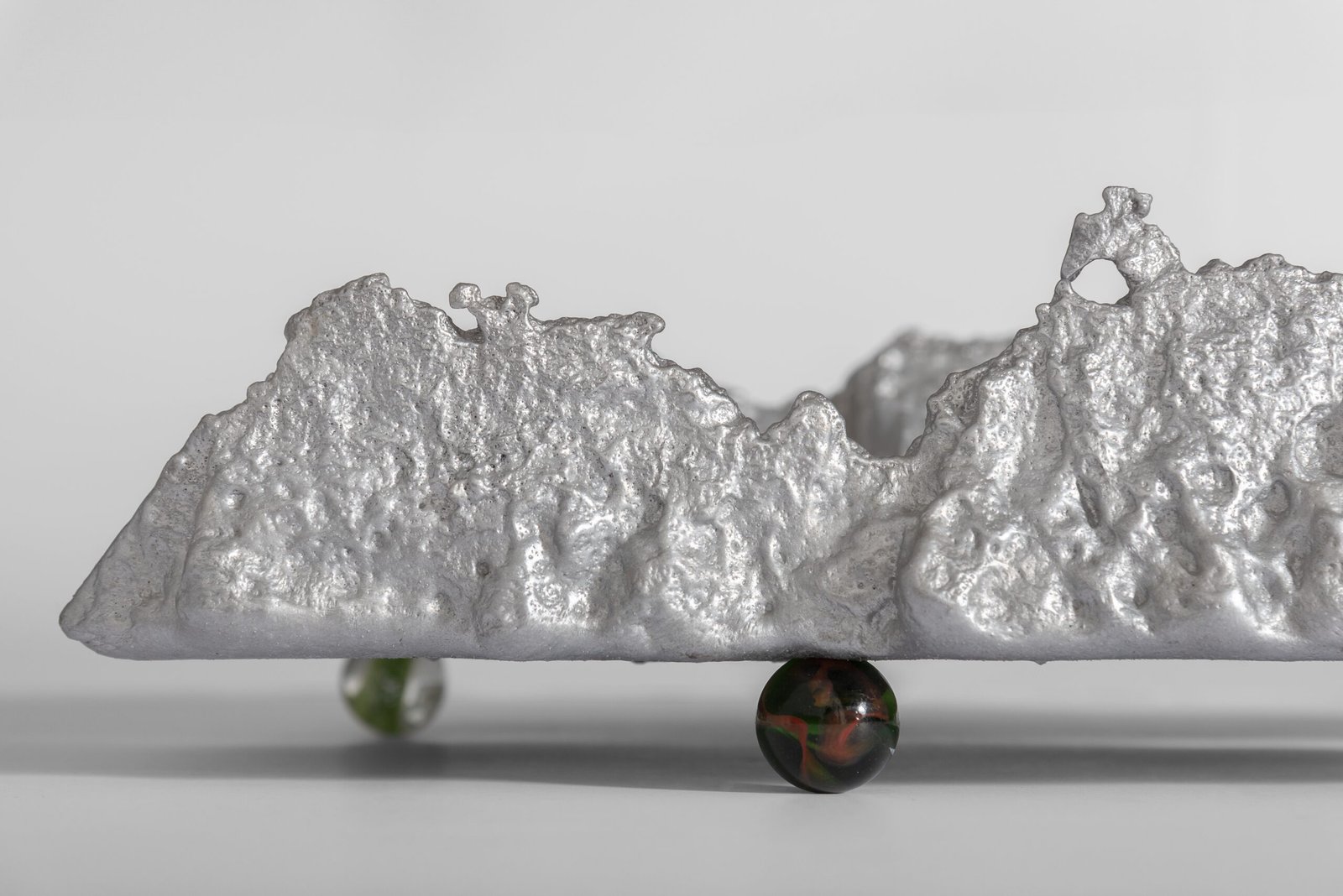
To this panorama another is added, even more earthy and three-dimensional. The gallery floor is dotted with a series of five works resembling clumps of soil. This is an entirely new kind of production for Marco Emmanuele, who created aluminum castings of portions of sand furrowed by what appears to be a hand (and, in this regard, the title seems to open up yet another interpretation: could the palm be that of the hand pressing into the sand?). The gesture of the hand — thus of a body — cutting through the sand evokes the idea of an exchange between landscape and action: it is a human movement that shapes the panorama, that somehow makes it form. Emmanuele crystallizes that piece of sand through a classic act of material transfiguration (in this case, something soft or pliable becoming solid), but adds another layer: to carve the sand, the artist used iron plates cut by laser to match the profiles of five poets’ faces. Dario Bellezza, Giorgio Caproni, Jolanda Insana, Lucio Piccolo, Valentino Zeichen: it is the silhouettes of their faces that mould those grooves, in an act meant to honor these authors by bringing them close to something carnal and earthly, much like the language of their poems.
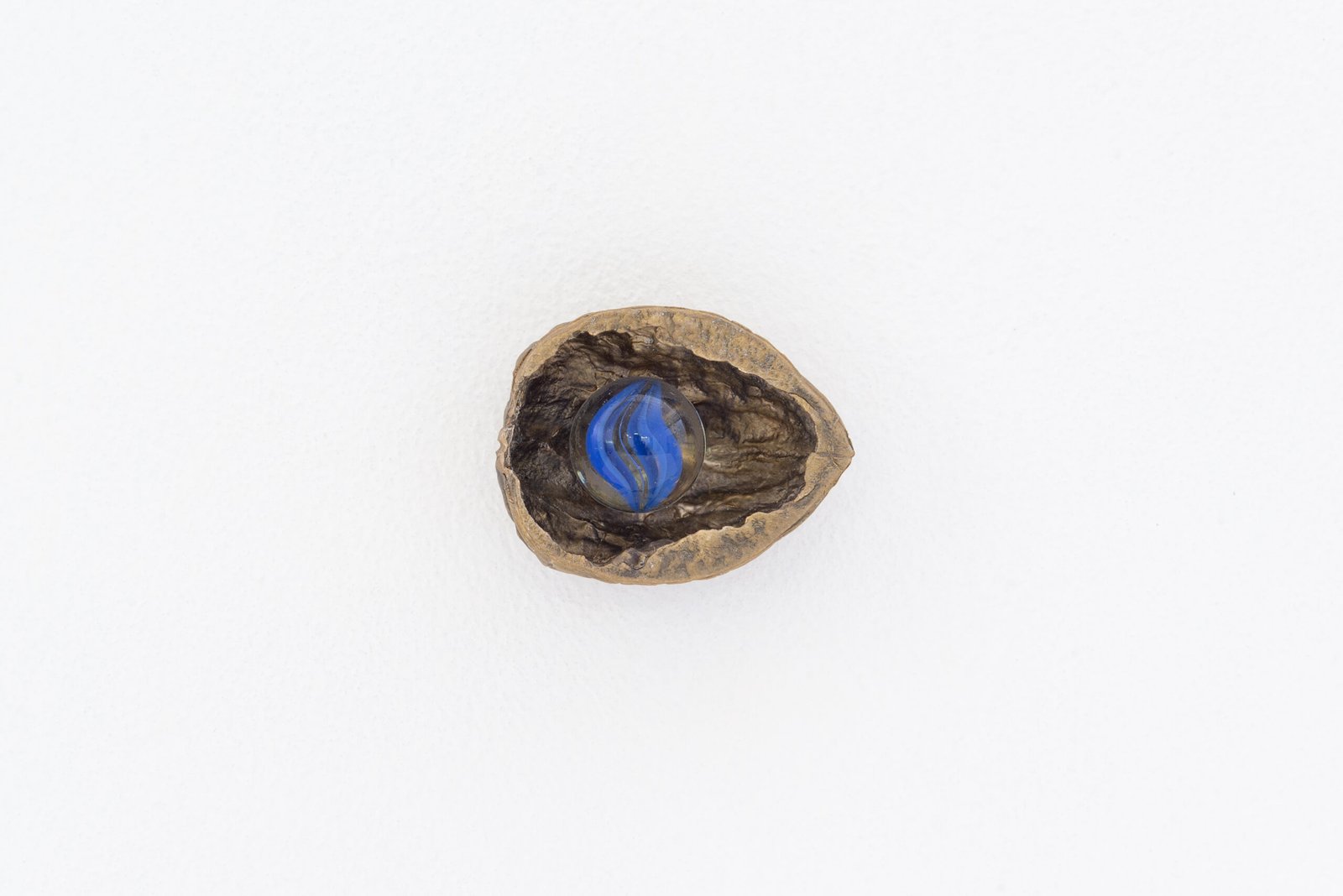
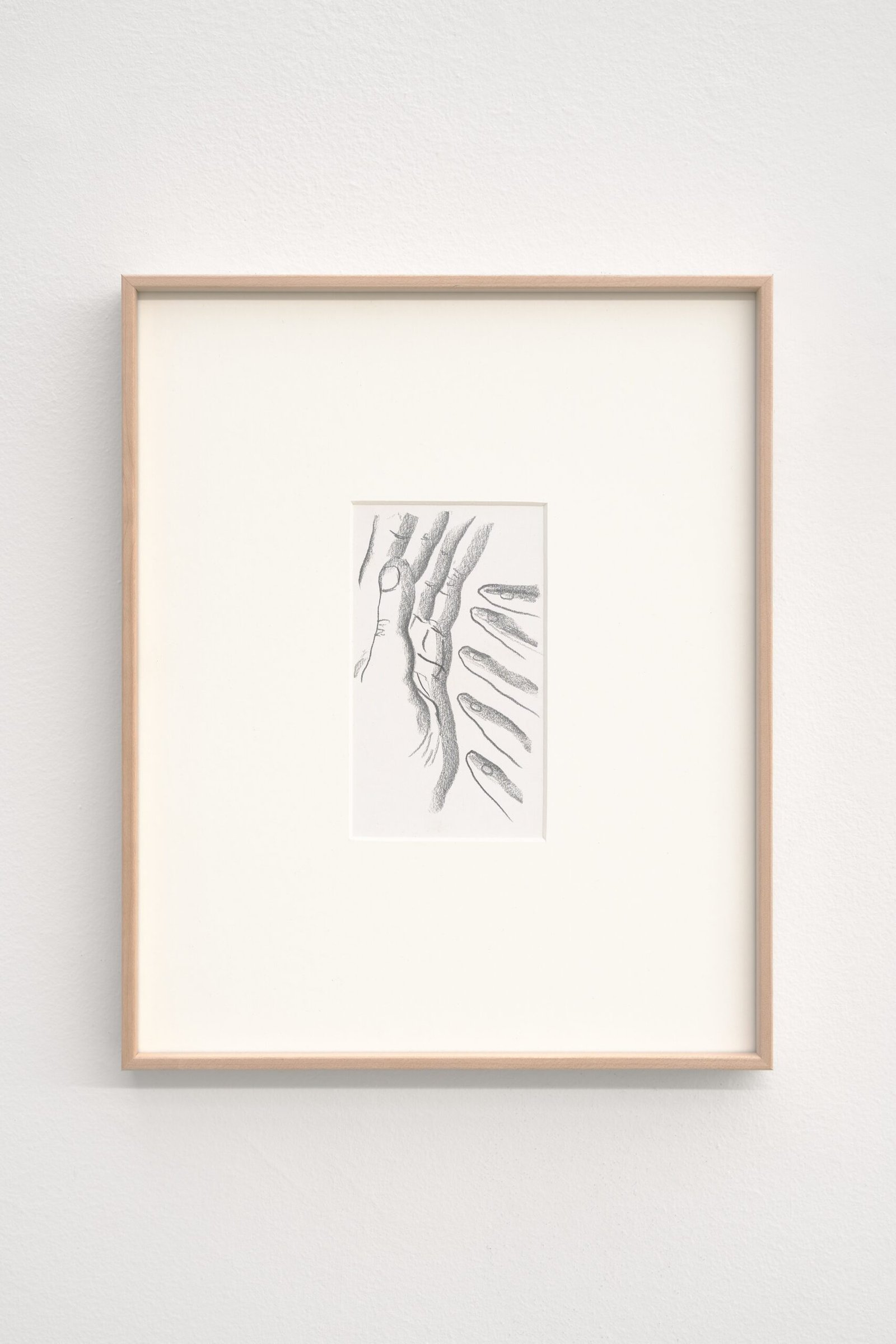
Looking at these works, one is once again reminded of a small demiurge at play. A child who, on the beach, sculpts a track for marbles: this is the strongest image evoked by the Ruscente series, suggested precisely by the presence of small glass spheres that — like discreet plinths — support the aluminum castings. The marbles lift the sculptures slightly off the ground, creating a minimal yet striking effect of suspension. This floating quality is one of the precious details with which Emmanuele has chosen to punctuate the exhibition. Palmo panorama certainly owes much to the large scale, starting from ISO #250, but subtler notes should not be underestimated: the marbles, indeed, as well as the small drawing of two hands brushing lightly against each other, underscoring — at least in my view — the importance of gesture in the artist’s practice, the value he places on making. The drawing is displayed in a secluded spot, almost to be discovered: much like Occhio di bimbo viperino, which likely reveals itself to most only at the end of the visit. The work is the bronze cast of a walnut shell, like an eye socket containing an eyeball represented — once again — by a small glass marble. At the beginning, we spoke of ISO #250 as the queen of the exhibition; yet, I find the small eye surprisingly powerful, like an unexpected “ghost track” at the end of a music album, or like an amulet found by chance on a beach in autumn. I enjoy imagining this work as the peephole through which that unknown and messy god watches — a proper voyeur — the exhibition he himself has generated.
Saverio Verini